
.png)
Use design strategy to boost young people taking Healthcare Power of Attorney(HPOA) seriously and filling out the form before a potential medical emergency.
UChicago Medicine
Sharon Markman MHA,
Director, Center for Healthcare
Delivery Science and Innovation
Primary Research
Service Blueprint
Communication Design
Prototyping
User Testing
5 Months:
Yiwen Teng
Brayan Pabón
Nishanth Srikanth
Shirin Navgire
Snehal Khatavkar
Dennis Siegert
Accidents always happen at unexpected moments, and no one can be prepared for them. That's the importance of Healthcare Power of Attorney, which can protect you when the unexpected happens. But in the UChicago Medicine records, less than 1% of patients between the ages of 25 and 40 have an HPOA form.
Reduced the average time required to fill out the HPOA form by 30%.
Decreased errors in form submissions by 25% through improved form design and usability.
85% positive feedback rating from healthcare providers for the streamlined interactions and usability of the new HPOA form.
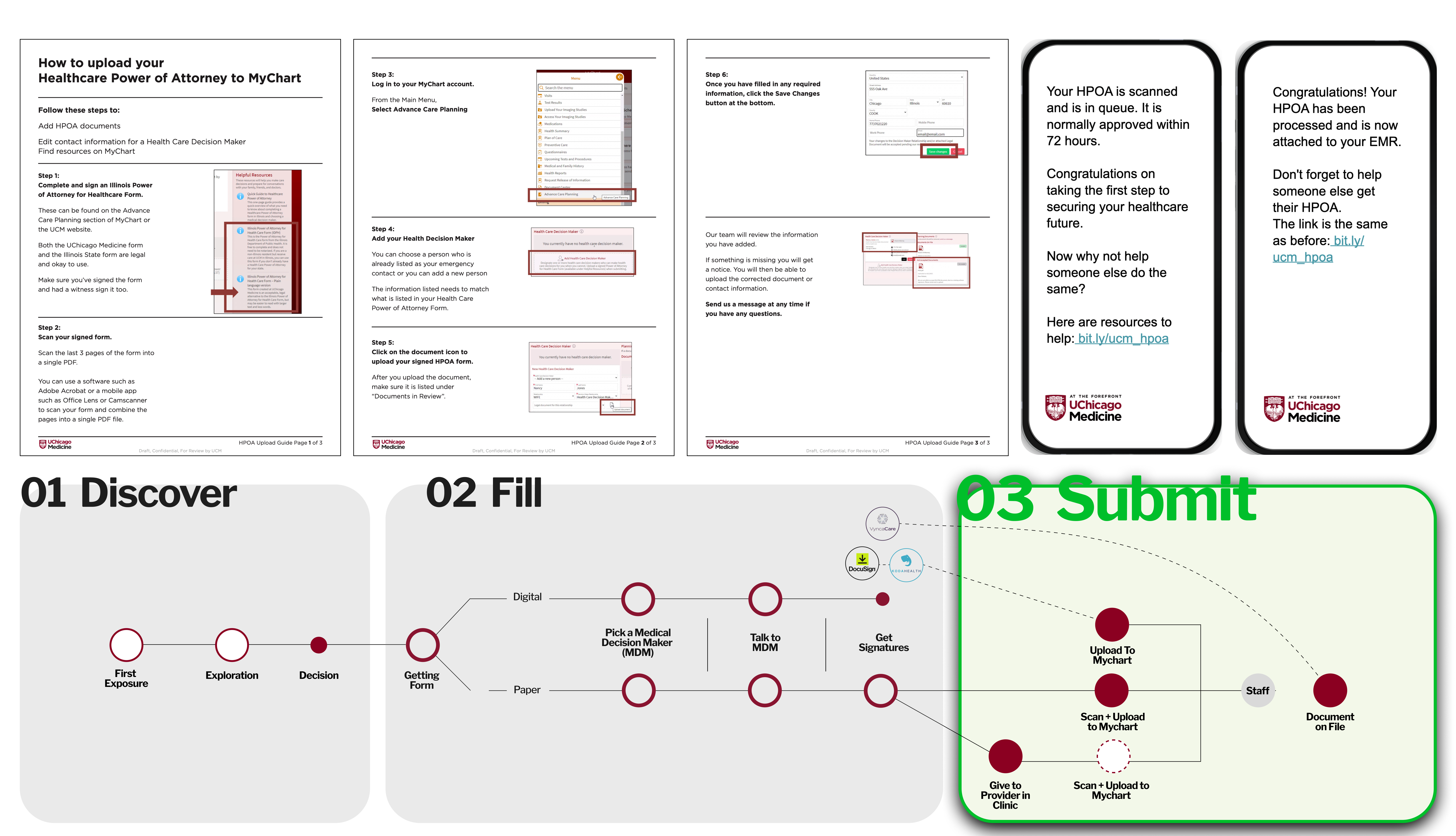
We identified 3 distinct phases in the patients’ journeys, and provide various of material in each touchpoint include: Poster, Billboard, Website Banner, Brochure, Illustrated guide, HPOA Official Form, Patients Guide and Communication loop.
.png)
.png)
.png)
.png)
.png)
Engaging in contextual interviews within the hospital environment underscored the significance of nuanced communication. By actively listening and closely observing in the context of users' natural surroundings, I honed our approach to gather deeper insights. This allowed me to align my interview strategies with design thinking principles and business agility, ultimately leading to a refined solution that truly resonates with both patient experiences and hospital workflows.
Communicating with UCM’s non-medical staff, I had to be clear about our project's value and how it aligns with their roles. Conversations had to be tailored: board members were interested in strategic fit, financial officers in cost implications, and HR in integration with staff training. This experience highlighted the need to balance diverse business interests with our social science insights and design goals to drive organizational change.
Interviewing young people revealed the importance of empathy in design thinking. By genuinely understanding their views on health and invincibility,I'm able to redesign the HPOA form to better resonate with them. This empathetic approach, a cornerstone of social sciences, guided us to a solution that is not only more user-friendly but also more likely to be adopted by its intended audience.